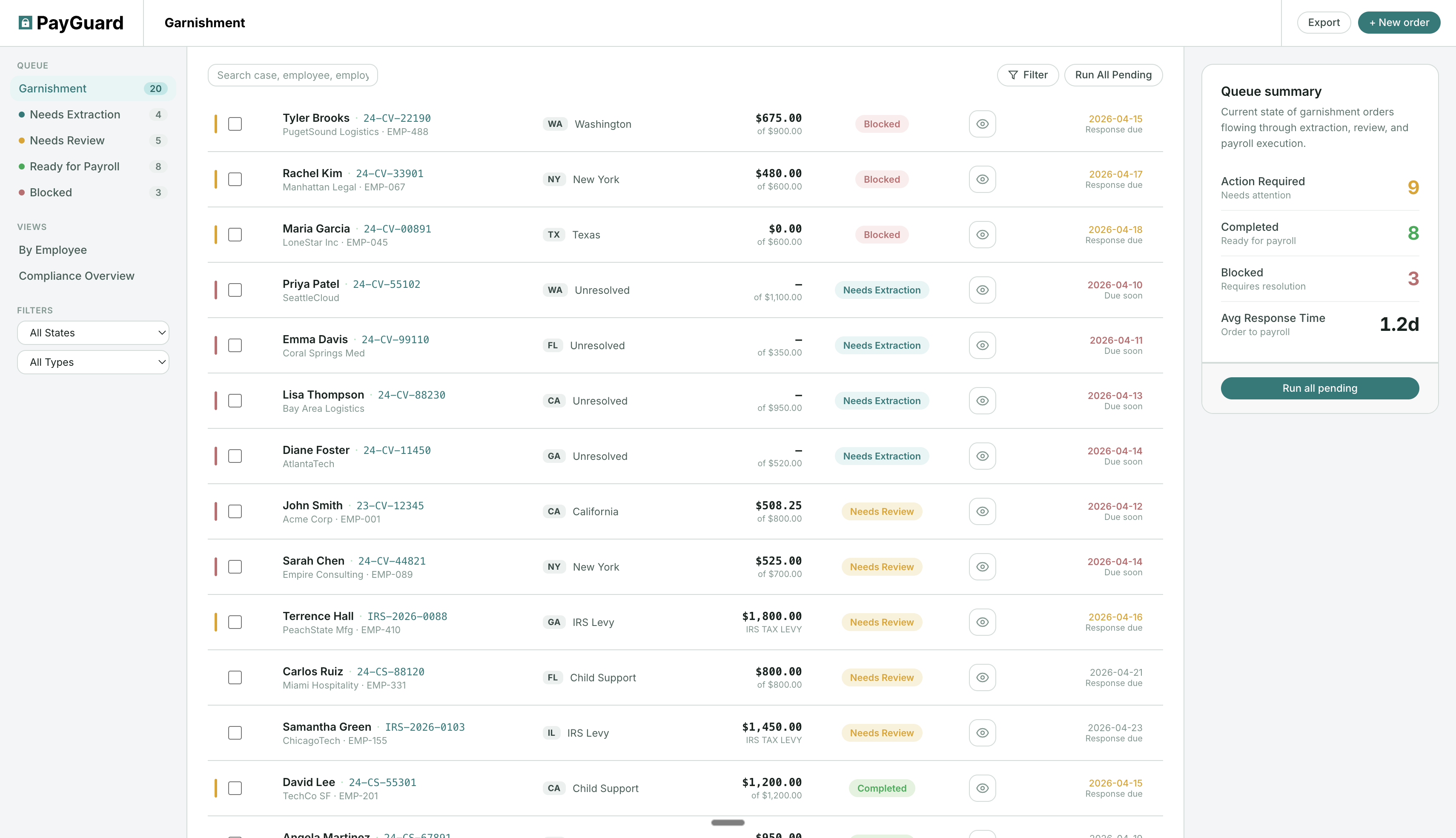
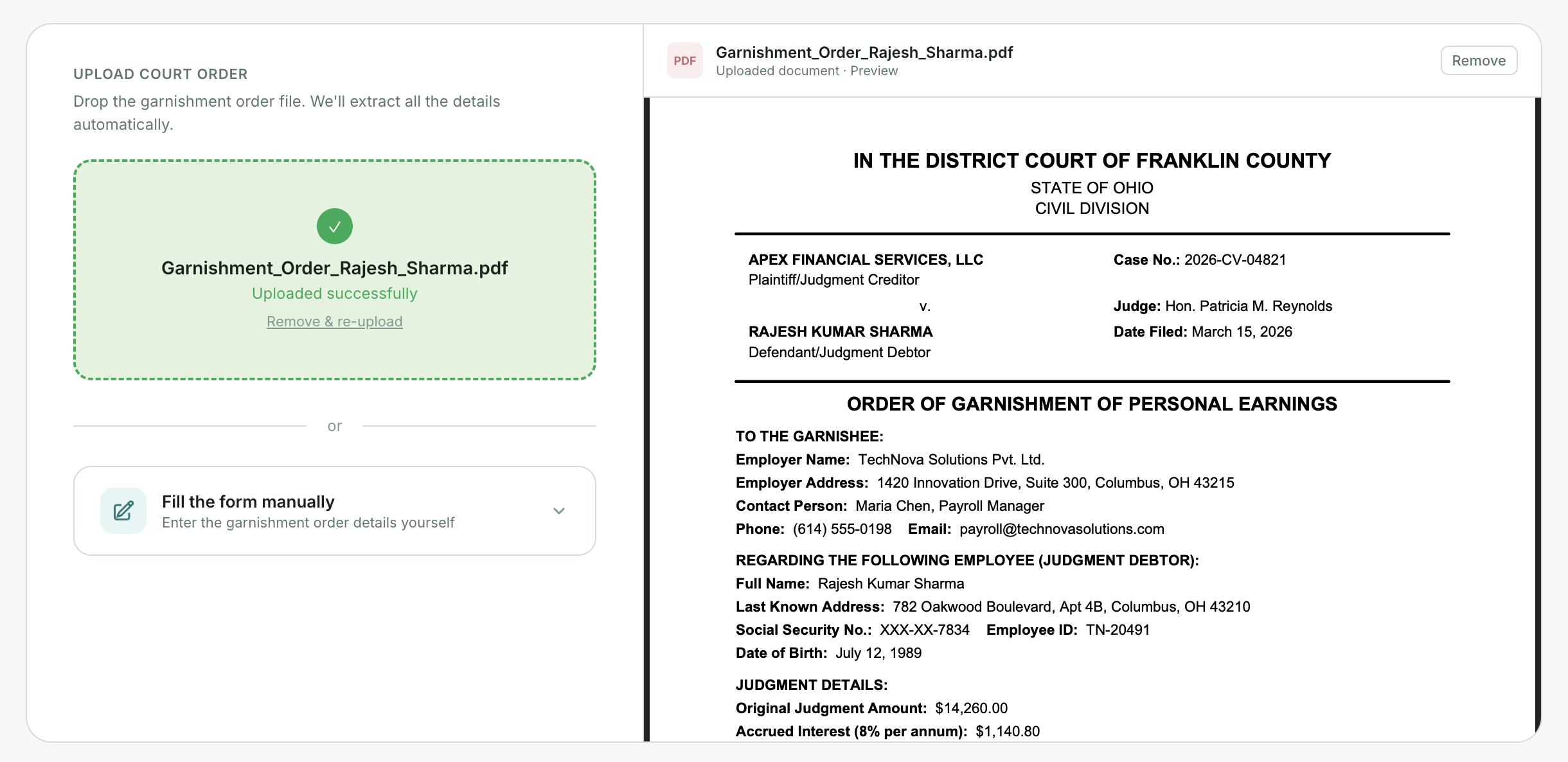
Garnishment order intake and classification
Reads court-issued garnishment orders — child support, creditor garnishments, tax levies, student loans — and classifies them by type, jurisdiction, and priority category.
PayGuard reads court-issued garnishment orders, applies federal and 50-state calculation rules, handles multi-order priority stacking, and produces payroll-ready withholding instructions with a statutory citation for every dollar withheld.
Become a design partnerWhat It Does
Every dollar withheld carries a statutory citation. Every calculation is documented. Every priority decision is traceable. The Why-Trail is ready before the employee challenges the withholding.
When an employee challenges a garnishment withholding in court, the employer must produce the calculation basis. PayGuard generates the Why-Trail at the moment of calculation — not retrospectively. 50-state rules, multi-order priority stacking, disposable income calculation. Every step cited.
Reads court-issued garnishment orders — child support, creditor garnishments, tax levies, student loans — and classifies them by type, jurisdiction, and priority category.
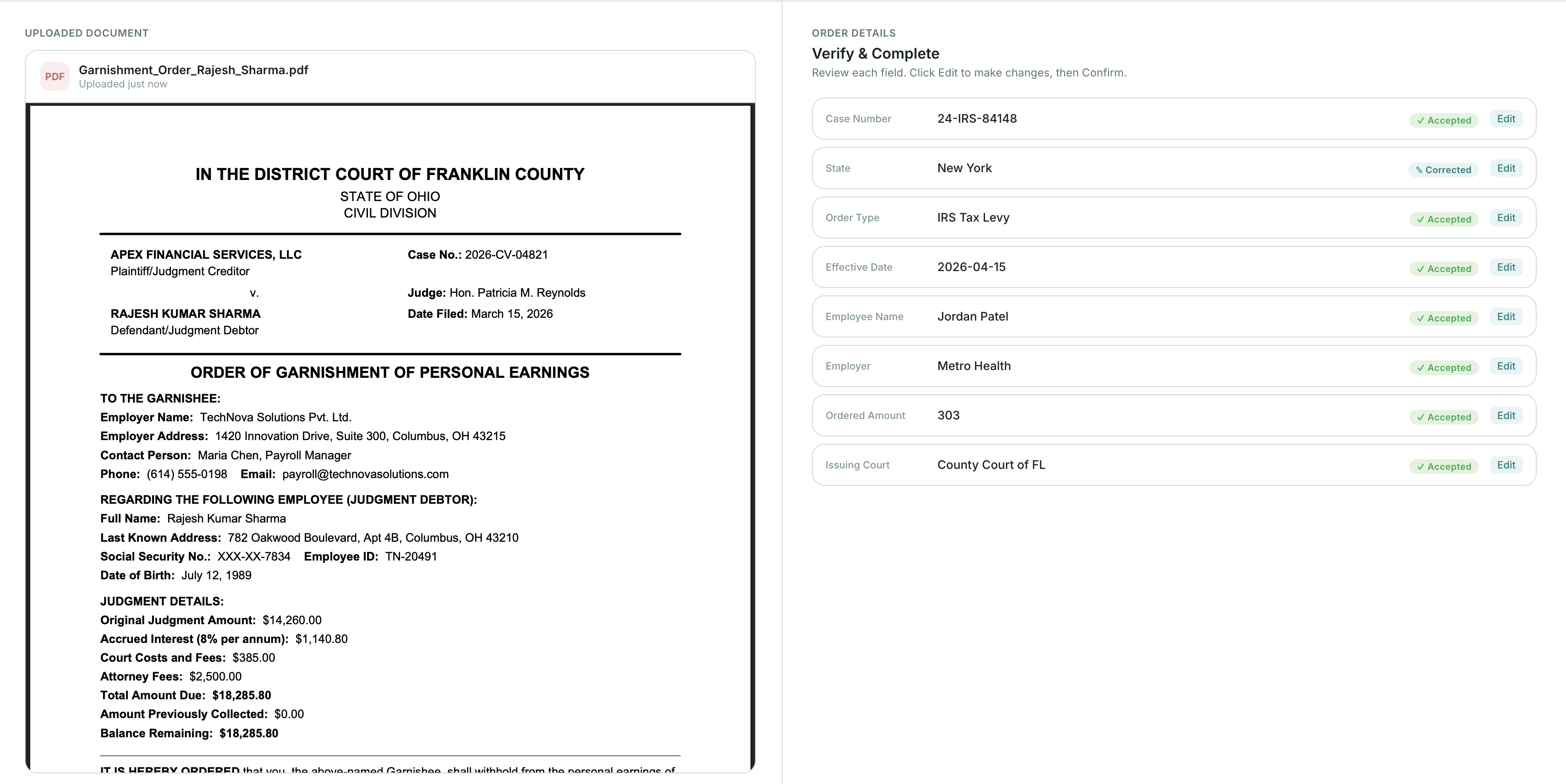
Applies federal Consumer Credit Protection Act (CCPA) limits alongside the applicable state's garnishment rules. When state rules are more protective than federal, state rules apply.
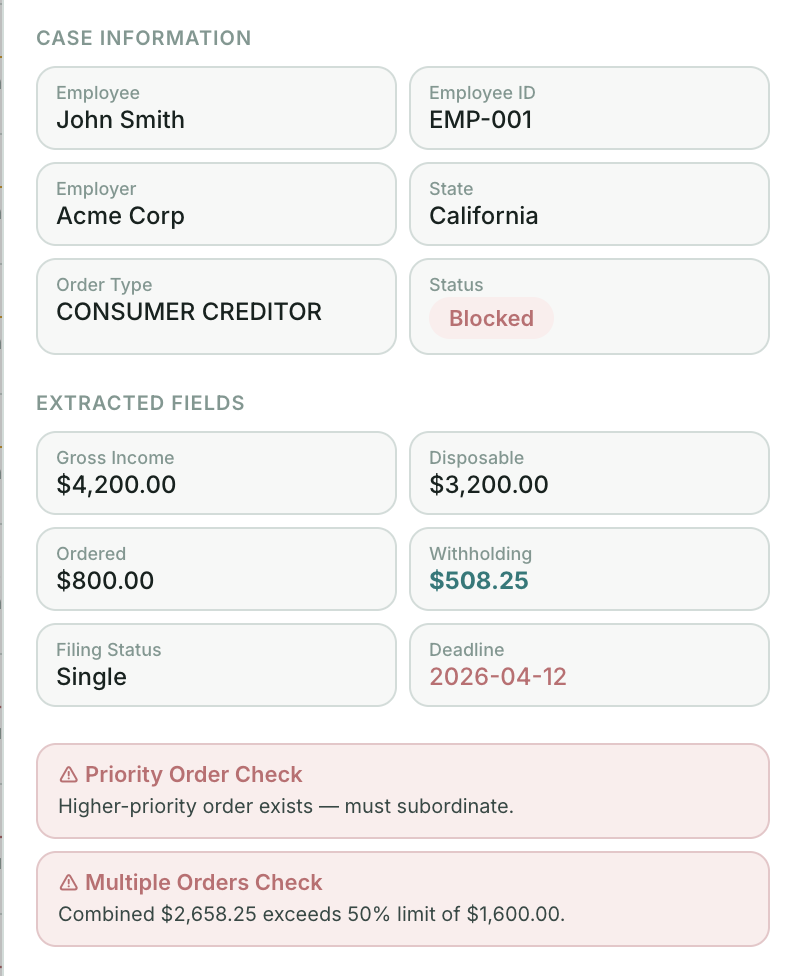
When multiple orders exist, PayGuard applies legal priority sequence — child support first, then tax levies, then creditor garnishments. Calculates disposable income correctly before each order.
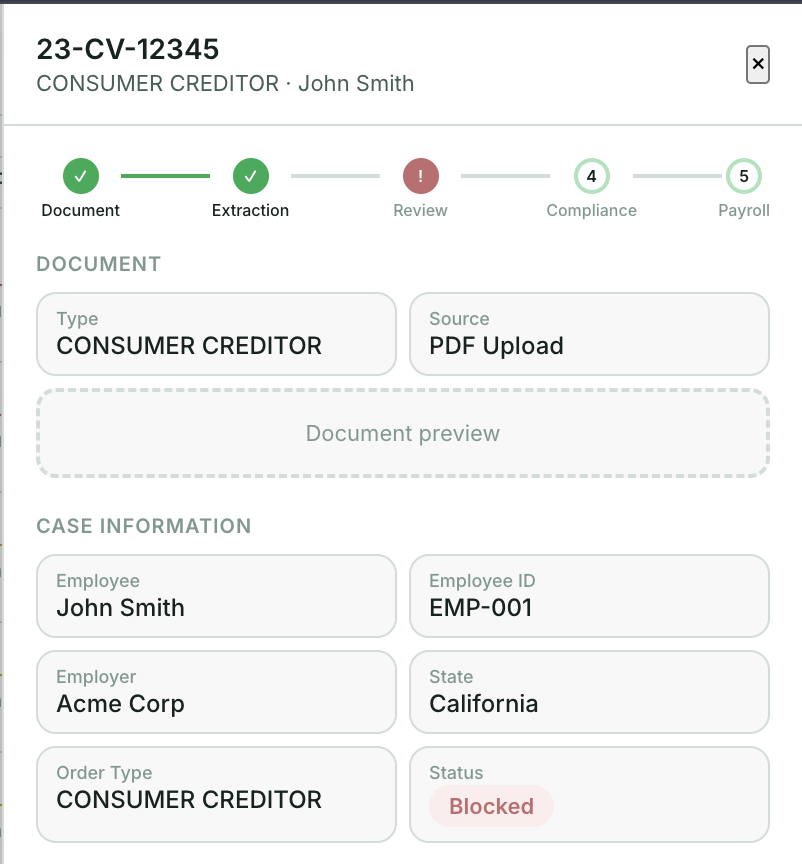
Outputs payroll-ready withholding amounts with a statutory citation for every dollar withheld and a complete Why-Trail audit document showing the full calculation chain.
Incorrect withholding under a garnishment order exposes the employer to court sanctions, employee lawsuits, and IRS penalties. Most payroll systems execute the calculation but cannot produce the statutory basis when asked.
Homegrown spreadsheets become outdated as state rules change and lack the auditability required when employees challenge withholding amounts in court.
ADP and similar systems calculate garnishment amounts but cannot explain the statutory basis. When an employee disputes the withholding, there's no audit trail to produce.
Employees with multiple garnishment orders receive incorrect withholding when orders are processed out of legal sequence. Liability accrues to the employer.
FAQ
PayGuard handles child support and spousal support orders, creditor garnishments, tax levies (federal and state), student loan garnishments, and bankruptcy wage orders. All types are classified at intake and processed with type-specific rules.
PayGuard outputs payroll-ready withholding instructions via API or file export compatible with major payroll systems including ADP, Workday, Paychex, and UKG. It sits upstream of payroll execution, not inside it.
PayGuard applies legal priority sequencing: child support orders first (up to 50-65% of disposable income depending on family status), then federal and state tax levies, then creditor garnishments. Disposable income is recalculated for each order in sequence.
Yes. PayGuard identifies the applicable state based on where the employee works and applies that state's garnishment rules. For remote employees in multiple states, it tracks which rules apply to each pay period.
The Why-Trail is a complete audit document showing the full calculation chain: disposable income calculation, CCPA limits applied, state limits applied, priority sequence, and the final withholding amount with a statutory citation for each step. Formatted for court and regulatory review.