The reality
Loan applications arrive as 200-page PDFs. Tax returns scanned at odd angles. Bank statements in dozens of formats.
THE PLATFORM
MightyBot's Document Intelligence Pipeline classifies, extracts, and indexes financial documents with 99%+ accuracy. Messy inputs are the default.
Why MightyBot
MightyBot's Data Engine turns messy, inconsistent documents into structured, policy-ready data with 99%+ extraction accuracy. The Document Intelligence Pipeline classifies pages, extracts values at character-level precision, canonicalizes to a standard financial reporting structure, and links every data point back to its exact source location. Messy inputs are the default.
The hardest workflows start with documents. Loan applications arrive as 200-page PDFs. Tax returns scanned at odd angles. Bank statements in dozens of formats.
Loan applications arrive as 200-page PDFs. Tax returns scanned at odd angles. Bank statements in dozens of formats.
Other AI platforms demo on structured inputs. The moment production documents arrive - 150 DPI scans, phone photos, inconsistent layouts - they fail.
MightyBot's Document Intelligence Pipeline classifies, extracts, and indexes financial documents with 99%+ accuracy. Messy inputs are the default.
Four stages. Each purpose-built for production document messiness.
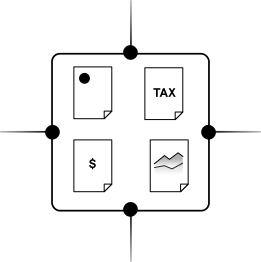
Every page classified independently. A 200-page loan package segmented into tax returns, bank statements, pay stubs, appraisal reports.
Each page processed by models tuned for its document type. Character-level boundary detection for dollar amounts, dates, percentages, names, and addresses.
Extracted values mapped to a canonical Financial Reporting Structure so downstream policy evaluation works consistently regardless of source format.
Every extracted value maintains a traceable link to its source - the specific page, the specific location, the specific document.
Three-tier indexing. Each level serves a different purpose.
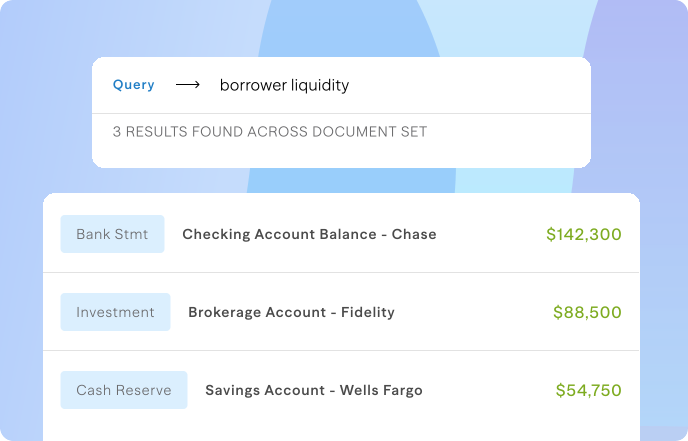
Semantic search across all processed documents. A query for "borrower liquidity" returns bank balances, investment statements, and cash reserves. Search understands financial terminology.
FAQ
PDFs (native and scanned), images (JPEG, PNG, TIFF), phone photos, Office documents, spreadsheets, and multi-page forms - regardless of scan quality, rotation, or formatting. Messy inputs are the default.
99%+ in production. Document-type-specific models and character-level boundary detection maintain precision even on low-quality scans. A production number, not a benchmark.
It maps extracted values from different formats to a standardized schema. "Net Operating Income" and "NOI" resolve to the same canonical field, so evaluation stays consistent regardless of source format.
Every extracted value links to its exact source - page number, coordinates, and document in the original upload. Auditors can click through from any decision to the source data.
Per-workflow repositories scope access at the architectural level. Each loan file has its own repository. Not a permission setting. An architectural guarantee.
It is optimized for English-language financial documents today. Additional language support is available for specific document types and deployment needs.