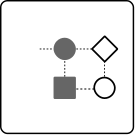
Where rules live today
Procedure manuals. Tribal knowledge. Twenty-year employees. Your policies are scattered across systems and people.
The Platform
Plain English business rules become executable policies. No code. No flowcharts. 200+ policy library. Git-native versioning. Policy to production. Same day.
Why MightyBot
MightyBot's Policy Engine converts plain English business rules into executable, versioned policies that agents enforce across every transaction. No code. No flowcharts. A 200+ policy library ships out of the box. Write a rule in the morning, deploy it by afternoon. Policy to production. Same day.
Every regulated organization has the same problem. The business rules that govern operations are trapped in procedure manuals, tribal knowledge, and the heads of people who have been there for twenty years.
Procedure manuals. Tribal knowledge. Twenty-year employees. Your policies are scattered across systems and people.
Traditional rules engines forced compliance teams into brittle nested conditionals. Every policy update became an engineering project.
The people who know the rules cannot update the rules directly. A translation layer sits between policy and execution.
Policies are written in plain English by your compliance officers, underwriters,
and operations managers.
That is the policy. The engine compiles it into deterministic evaluation logic.
Every application evaluated consistently. Every evaluation traceable to the source
rule.
The people who know the rules write the rules. The engine enforces them.
Compliance officers, underwriters, and operations managers — not engineers.
The engine compiles plain English into evaluation logic that runs consistently on every transaction.
Every application evaluated consistently. Every evaluation traceable back to the policy that governed it.
MightyBot ships with over 200 pre-built policies: regulatory compliance checks, credit risk thresholds, document completeness validation, covenant monitoring, underwriting guidelines, anti-fraud rules, and KYC / AML screening. These are battle-tested starting points, not rigid templates. Your team customizes them to match specific requirements. The library turns a months-long deployment into weeks.
200+ financial institutions already run on these policies.
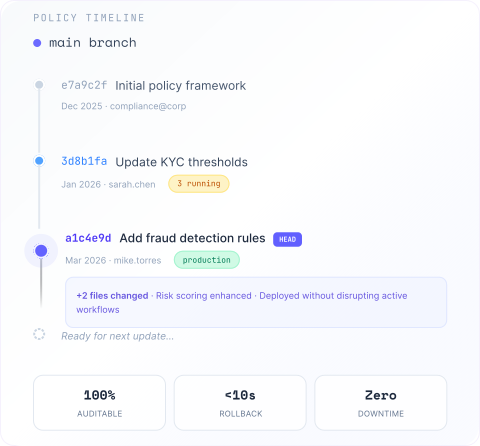
Every policy change is version-controlled. Full history. Every version timestamped, attributed, and auditable.
When a compliance officer updates a policy, the previous version remains accessible. Audit teams see exactly which version was in effect when any decision was made. Policy updates deploy without disrupting in-flight transactions.
Ship workflows as versioned definitions in Git. Roll back in seconds. Audit across any time window.
Write rules in natural language. Attach validation criteria. Set enforcement behavior — hard block, soft warning, or flag for review. Each policy links to the data fields it evaluates.
Write in natural language. Attach validation criteria to each rule.
Set enforcement behavior — hard block, soft warning, or flag for review.
Test in sandbox against historical transactions. No risk to live workflows.
Deploy to production. Same day.
FAQ
No. The Policy Authoring Studio is built for compliance officers and business users. Write in plain English, test in a sandbox, deploy without code. Your compliance team owns the rules.
Policies have defined precedence. When rules overlap, the engine applies the most restrictive applicable rule. The full evaluation chain is logged for audit.
Yes. The sandbox runs policies against historical transactions so your team can validate behavior before anything goes live.
In-flight transactions continue under their starting version. New transactions pick up the latest policy set. Both are preserved with full change history.
Regulatory compliance, credit risk, document completeness, covenant monitoring, underwriting guidelines, anti-fraud, and KYC / AML across lending, insurance, and payments.
Yes. Policies enforce at the agent execution layer across connected systems. A single policy can evaluate document data, system-of-record fields, and API context in one pass.